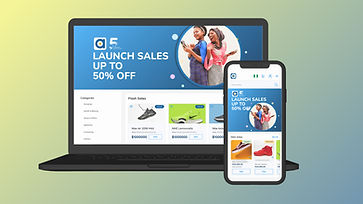
What was done
I led the end-to-end visual and UX design of Ayoba Shop (web) as a greenfield product, designing the marketplace experience entirely from scratch. This included defining the core information architecture, designing the homepage and category navigation, creating product listing and product detail templates, and building the cart and multi-currency checkout flow.
I also established a foundational design system with reusable components, tokens, and documentation to support scale. The experience was built mobile-first, and fully responsive from day one in order for it to seamlessly fit into the existing Ayoba app. Throughout the project, I collaborated closely with product management, legal, engineering, data, and business operations.
You can access the live website or view the figma designs. Some of the research is also available to view on figma
Below are some screenshots

Why was it done
Ayoba was expanding its platform into e-commerce and needed a marketplace experience that could support multiple countries, currencies, and regulatory requirements from launch. The goal was to create a trustworthy, easy-to-use buying and selling experience that could scale quickly across regions while keeping operational overhead low.
Early discovery showed that both buyers and sellers were unfamiliar with the brand as a commerce destination, which made clarity, pricing transparency, and trust signals critical. Sellers needed a simple, guided way to list products without heavy manual support, while buyers needed intuitive discovery, clear category structures, and confidence during checkout.
These goals had to be achieved under real constraints, including limited engineering capacity, strict payment and compliance requirements, and the complexity of localization across markets.
How was it done
I began by working with stakeholders to define the product vision, success metrics, and non-negotiable constraints. Through workshops, we aligned on business KPIs such as conversion, time-to-first-listing for sellers, and checkout completion. I then conducted landscape research across regional and global marketplaces, to understand expectations and mental models. Because there was no existing product data, this qualitative research played a key role in shaping early decisions.
Using these insights, I defined the core flows that would form the foundation of the marketplace: discovery to purchase for buyers. I mapped these flows end-to-end before moving into low-fidelity wireframes to test structure and hierarchy. Once validated internally, I developed high-fidelity prototypes for mobile and desktop, establishing visual language, interaction patterns, and content hierarchy.
In parallel, I created a tokenised design system to ensure consistency and scalability, defining typography, colour, spacing, and component variants such as cards, filters, modals, and form elements. Particular emphasis was placed on pricing clarity, multi-currency handling, trust signals like return policies and seller ratings, and accessible controls.
Designing from scratch meant making foundational decisions early with incomplete information. Some advanced features, such as personalised recommendations, were intentionally deferred due to backend constraints, but the UI was designed to accommodate them later without disruption. Another challenge was balancing a globally consistent experience with country-specific legal and UX requirements, which was solved through configurable components and localised content modules.
For delivery, I partnered closely with engineering through annotated Figma files, and several walkthrough and QA sessions, to ensure the experience was implemented accurately.
Conclusion
Ayoba was absorbed into its parent company, and as a result the marketplace got sunsetted.